
THE POWER OF THE COUNTER-ATTACK : LIVERPOOL
A data driven study into one of the key areas the Premier League Champions have developed over the last five years
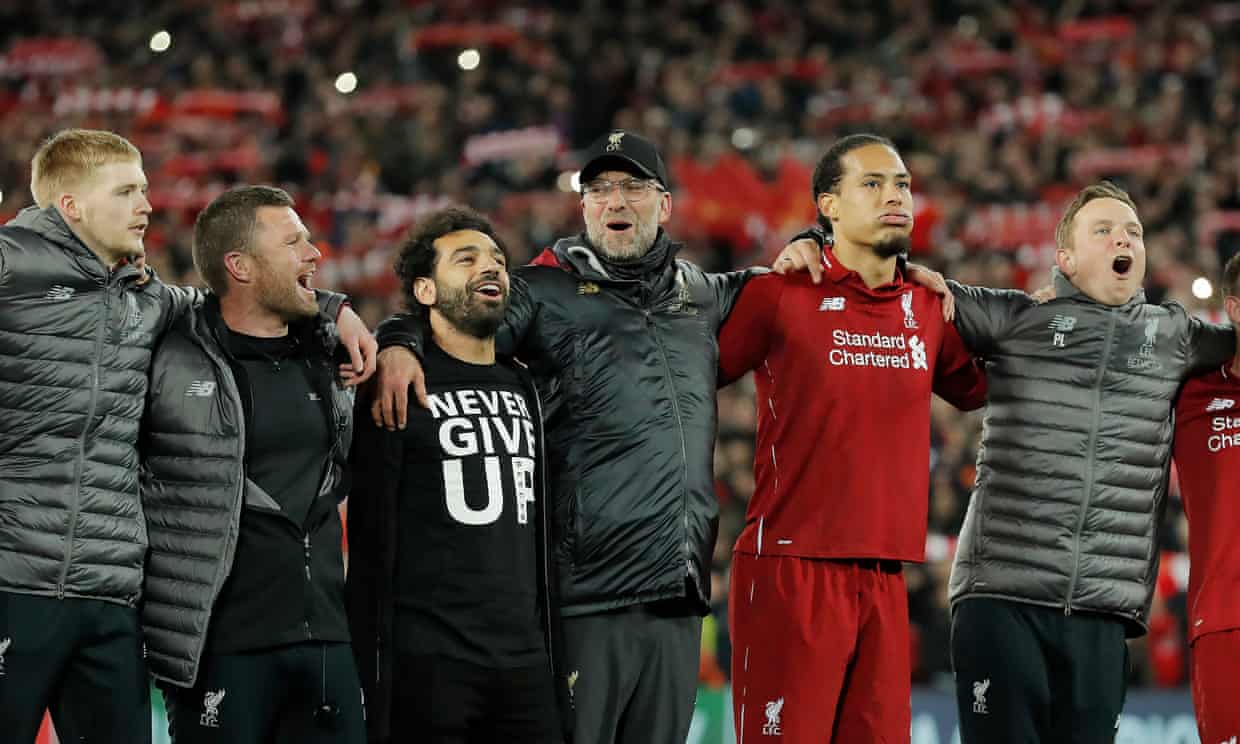

Liverpool are champions of the Premier League for the first time ever, and English league champions for the first time since 1990.
Manager Jurgen Klopp has rightly won admirable glances for his team’s exciting, attacking, style of play over the last five years, leading up to the title winning campaign.
During that season Liverpool became more controlled in possession. Still an attacking force (85 league goals) but with the handbrake slightly on.
When working for Sky Sports only weeks before becoming manager of Tottenham Hotspur last October, Jose Mourinho argued that Liverpool still preferred to play against teams that allowed them to break at pace.
Indeed, the combination of Mohammed Salah and Sadio Mane fluidly changing defence to attack, is often cited as one of the cornerstone tactical innovations of this team.
Yet when watching Liverpool last season it was clear, teams now allow them far less space in behind to exploit in transition.
In addition, their season average possession percentage was 59.6%. On the surface they seem to have completely transitioned into a team that looks to dominate from the word go, as opposed to sitting deep and lulling the opposition forward.
So, are Liverpool still at heart, a counter-attacking team? Let’s look at the data to find out.
The official opta statistics of the Premier League reveal that Liverpool scored 11 goals from counter-attacks over the course of the title-winning campaign.
A classic example would be the crowing goal in the excellent 4-0 win at Leicester City on Boxing Day.
After retrieving the ball back near the halfway line, Georginio Wijnaldum played a pass to Sadio Mane who drove forward at the Foxes backline, with Trent Alexander-Arnold charging on the outside of him to create an overload.
Mane slipped him the ball and the right-back did the rest, smashing the ball (first time) into the far corner.
The Reds opponents that day are the only other side in the league to score more than eight goals directly from countering.

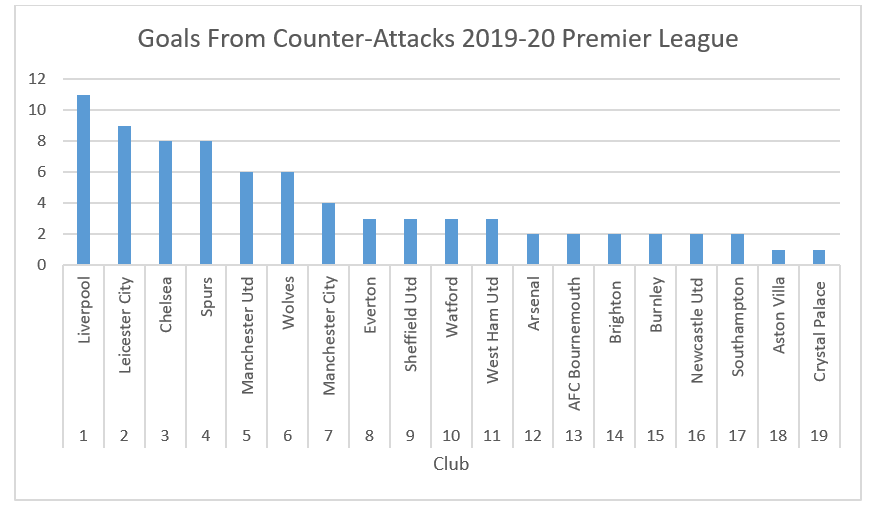
CA Goals 2019-20 : Source- Opta
CA Goals 2019-20 : Source- Opta
But is this part of a wider trend? Have the Reds become even more effective on the break than previously thought, reaching new heights?
A starting point is to compare last season to Klopp’s first full campaign.
That year Liverpool only managed to score 3 goals - yes 3- directly from a counter-attack, the same number as relegated Hull City.
At this stage though, the team were nowhere near the levels they have reached today. They were capable of beating the big sides who finished above them (Chelsea, Spurs, City) but slipped up against the lower teams who were adept at counter-attacking themselves (Burnley, Hull, Swansea).
Klopp was not coaching a team capable of hurting opponents on the break consistently, and this minimised goal-scoring opportunities.
His Dortmund team that reached the 2013 Champions League final had frightening pace in the wide forward areas and he realised Liverpool needed similar weapons in their arsenal to challenge for the title.


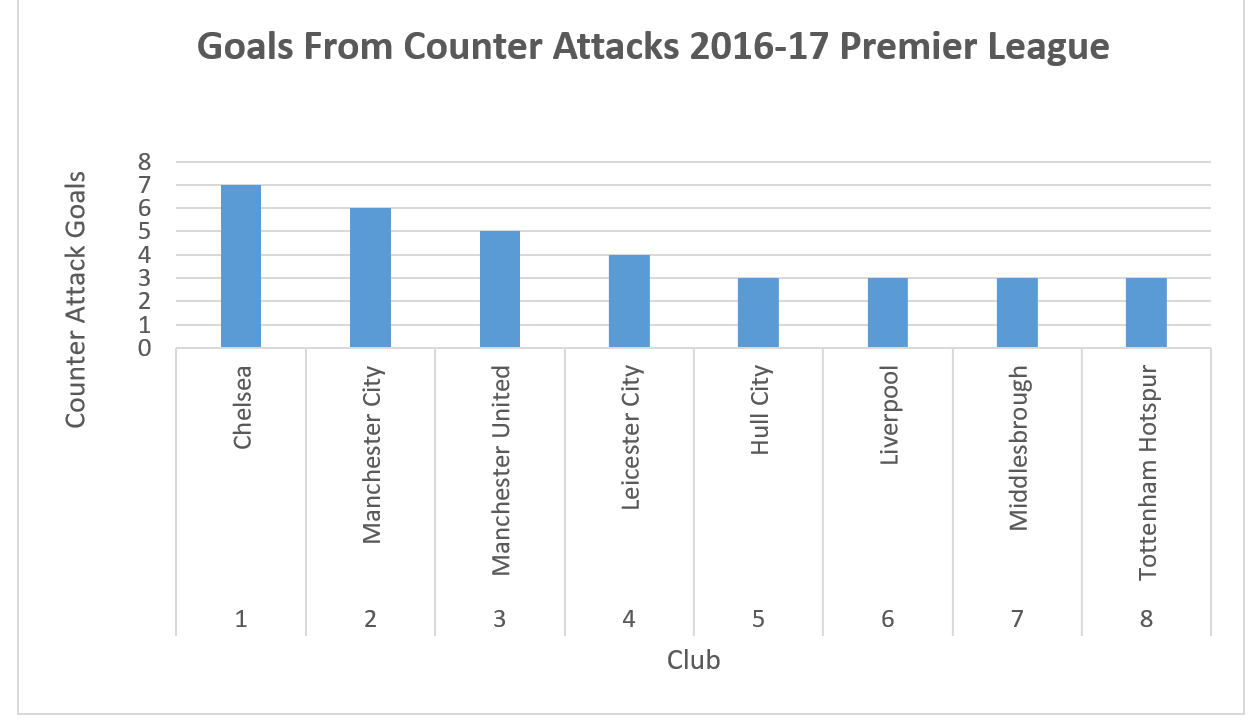
CA goals 2016-17 PL : Source - Opta
CA goals 2016-17 PL : Source - Opta
Even as recently as the 2018/19 season, in which Liverpool took an astonishing 97 points, a record number for a runner-up in the Premier League, they only had the third highest total of counter-attacking goals in the league – 6.
This was actually a small downgrade from 2017/18 (9) but still a respectable total.
That season only Leicester City and 14th placed Bournemouth had more, with 8 and 9 respectively. On a wider level it looked as if scoring goals through countering was going out of fashion.
Liverpool however, were starting to find more space for Salah and Mane to exploit on a regular basis. They just hadn’t quite added a completely ruthless touch.

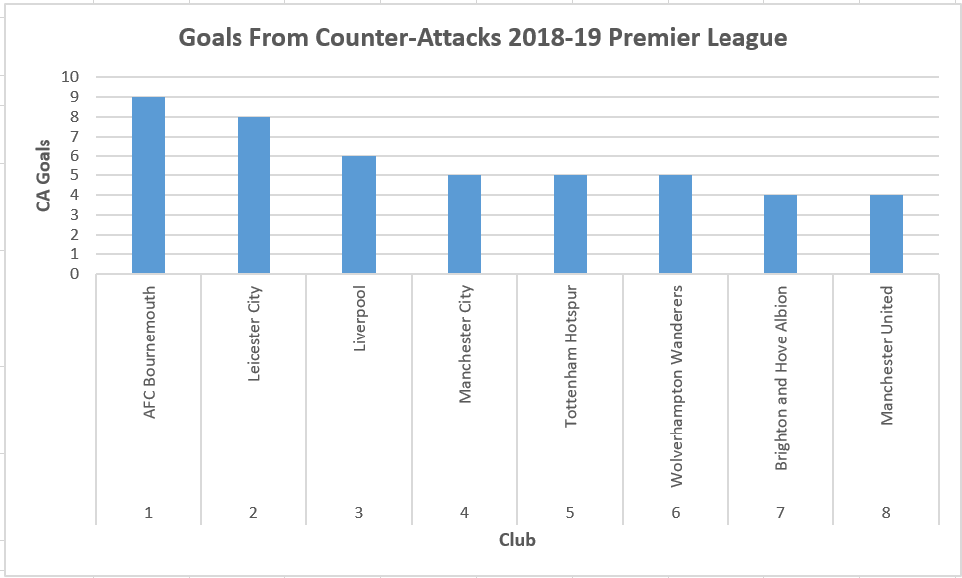
CA Goals 2018-19 : Source - Opta
CA Goals 2018-19 : Source - Opta
What they had added by this point, was strong runners from the full-back positions.
Alexander-Arnold and Robertson were now established starters in the team, primarily for their ability to fly forward into open space and create chances. Despite knowing this beforehand, opposition defences found it incredibly difficult to stop.
Both players offered such dynamism going forward and suddenly the team had multiple players who were brilliant at exploiting open space.
Their development was the sole biggest factor in jumping from the sixth best counter-attackers in the division, to the third best, in just 2 years.
This element to Liverpool’s approach was improving season on season. As shown by the stats, ‘gegenpressing’ was having a big impact.
In shorthand, the longer Klopp’s tactical blueprint has been set on the team, they have become far more deadly on the break.
LFC are ideally set-up to form fast counters from deep positions. 'False 9' Roberto Firmino is able to drop into space slightly in the opposition half pulling defenders with him and giving more space to run into for Mane and Salah, who interchange precisely.
This pattern of play can first be seen in the Reds 2017-18 Champions League run, with one of Salah’s goals against Roma at Anfield the perfect example.
This goal (which can be viewed below) was a watershed moment for the Reds.
Not only did it complete a wonderfully crafted team move.
It demonstrated their ability to score breakaway goals from all angles.
copyright: BT Sport Twitter
copyright: BT Sport Twitter
Equally, Liverpool have shown more recently that they can simply go route one of the counter when needed.
Perhaps this is because opposition expect them to build from the back and play out through the full-backs more. In turn this leaves them vulnerable to the basic long pass up field, particularly dangerous when Klopp has the one of the best passing goalkeepers around, in his ranks. The obvious example is the Salah goal against Manchester United from January.
The ball from goalkeeper Allison was inch perfect, and Salah was in behind the defence the moment the ball was played but it did highlight how moves on the break don’t have to be overly complex. When needed to Liverpool are perfectly capable of keeping it simple.
One statistic from Opta’s data collection stands alone as the biggest single testimony to how important counter attacking is to the Klopp machine.
The 2014-15 PL campaign was Liverpool’s most recent season, entirely without Klopp. Under the guidance of Brendan Rodgers, they scored precisely two goals on the break in 38 games.
Admittedly the Northern-Irishman’s footballing philosophy is on the other end of the spectrum compared with Klopp. He focuses on a slow tempo controlled, possession approach for the most part. Even so is a stark contrast with the Liverpool of today.

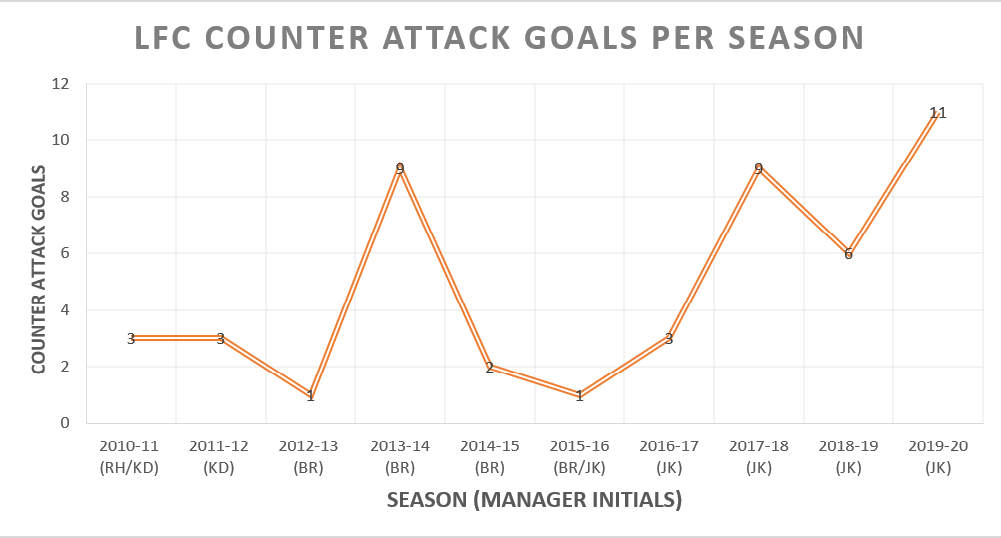
Liverpool counter attack goals by season
Liverpool counter attack goals by season
Conclusion
As the data shows, the pattern between improvement in counter-attacking and higher league position is clear.
When the former Dortmund manager walked into Anfield five years ago many could have predicted that a high-energy press, ‘false 9’, and fluid 4-3-3 formation would be central to his strategic approach.
Less predictable was the importance of being able to shift from defence to attack so quickly and aggressively, primarily through Salah and Mane.
Penetrating counters have virtually become a club trademark.
Next year as defending champions, opponents will be more guarded than ever before, to try and deny Liverpool space for the counter.
Don't be surprised to see teams be reluctant to send numbers forward on set-pieces, with this is mind.
Like all great managers, Jurgen Klopp will have to adapt and find new solutions, if he wants to retain the title.
But with Salah, Mane, Alexander-Arnold and Robertson still around and Takumi Minamino likely to prove an excellent understudy for Firmino in the ‘false 9’ role, don’t except Liverpool’s counter-attacking exploits to tail off anytime soon.
*All data used was sourced from Opta Sports the official media data partner for the Premier League.

 Built with Shorthand