
Reclaiming the Stretford End
Old Trafford's West Stand has long been viewed as the beating heart of Manchester United, where noise, unity, and defiance shaped the club’s identity. After a period in which that identity seemed to be getting lost, both the team and the fans are back on form. But why did the Stretford End need to be reclaimed, and what did it need to be reclaimed from?
By Carly Lyes
“The heart of Old Trafford.”
The phrase keeps popping up whenever people talk about the Stretford End, the legendary stand behind the western goal at Manchester United’s home stadium.
It's a phrase regularly used by fans, players, and the club itself to describe the part of the ground viewed as the physical and spiritual lifeforce of Manchester United’s fanbase. As the beating heart of Old Trafford, the Stretford End pumps life through the stadium, making it move and sway to the sound of 15,000 voices and pulse to the rhythm of 15,000 pairs of hands clapping in unison.
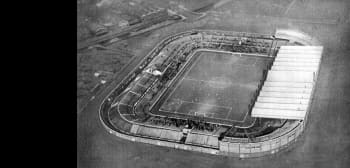
Once a sprawling concrete terrace, the Stretford End has passed through various incarnations over the last 116 years, but has remained the nerve centre of the movement, noise, and emotion of the club’s supporters, both during matches and in the wider public consciousness.
Ten years ago, that pulse was starting to feel a bit weak. Decades of reconfigurations, prices rises and deliberate tinkering by a club that some fans allege was more concerned with revenue than atmosphere had left the once fiery Stretford End, capable of reaching fever-pitch levels on a good night, a tepid imitation of its former self.
Since 2017, however, fan groups have been putting in the hard yards before, during, and inbetween matches, building relationships and communication channels with the club hierarchy to try and bring back Old Trafford’s once globally admired atmosphere. “Reclaim the Stretford End” has been the rallying cry at the heart of this work.
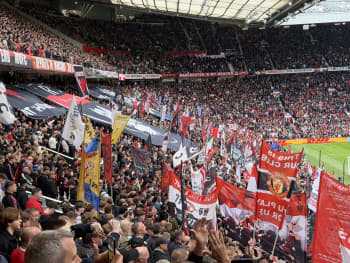
Now, in 2026, as Michael Carrick's appointment has seen the Reds resurgent, the Stretford End has also been revived, bursting with noise and colour again, thanks to the dedication of groups of fans who want to preserve its legacy as the emotional and cultural heart of Old Trafford. The Stretford End has been reclaimed.
But who, or what, did it need to be reclaimed from? What makes this slope of concrete with some seats attached, first built 116 years ago, such an enduring cultural icon that still has so much relevance and resonance in 2026?
"Bertie Mee said to Matt Busby,
'Have you heard of the North Bank, Highbury?' 'No,' said Matt,
'you Cockney t***,
but I've heard of the Stretford Enders!' "
The birth of a legend
Built as part of Old Trafford in 1910, the Stretford End existed in physical form for many decades before it became the vociferous Stretford End of lore in the early to mid 1960s. During this period of societal shift when young people were forming new subcultures, the Stretford End became a place where younger fans would gather. There was a lot to cheer about in the decade of George Best, Denis Law, Bobby Charlton, two league titles, and the club's first European Cup victory in 1968.
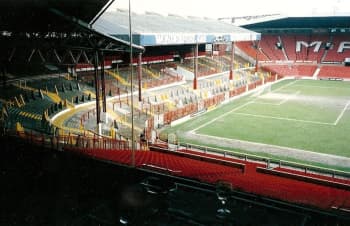
The 1960s were a vital milestone in the Stretford End mythmaking, but it was the 1970s "Red Army" era when the Stretford End really became the maelstrom of noise and passion - and sometimes “aggro” - that made it so beloved amongst fans. After European Cup-winning manager Sir Matt Busby retired in 1969, turbulent times came to Old Trafford, with a succession of managers, scandals, relegation, and other challenges making for difficult times in M16. The 1980s brought a mixed fortunes on the pitch, declining attendances, and a social and political environment in which football fans - very often all tarred with the "hooligan" brush - were treated increasingly as second-class citizens, herded into ever-declining facilities and crumbling terraces, which would eventually culminate in large-scale tragedy with the Hillsborough disaster in 1989.
Through all these ups and downs, the Stretford End of the 1970s and 80s provided fans with something constant - a place of belonging and community, where friendships and identities were formed amongst a swaying mass of bodies and bar scarves.
To understand more about why the Stretford End was so important to fans in the 1970s and 1980s, I went along to speak to some original Stretford Enders at the annual "Stretford Enders Reunion" at the Old Nags Head pub in Manchester city centre.
The reunion has been running for a number of years, and sees scores of Stretford End stalwarts come together to sing, reminisce, and raise money for the Manchester Munich Memorial Foundation (MMMF), a charity that supports youth projects in Manchester, Munich and Belgrade in memory of those who died in the 1958 Munich Air Disaster and which now coordinates the reunion event.
We are the Stretford Enders
Those fans who stood on the Stretford End of the '60s, '70s and '80s remember it as a place of youth, vitality and freedom, where their younger selves created memories and built bonds with other fans that would last a lifetime.
Stretford Ender Melissa Moore, 48, who went to games on the Stretford End as a child, told me: "We'd queue up from 11am, they'd open the doors at one-ish, and then we'd just play about for two hours before kick-off. We were there all day. That's how we all got to know each other so well."
As demonstrated in the video interviews below, Stretford Enders of that era emphasise the communal experience of the terrace, the visceral sensation of being one tiny part of a collective wave of humanity, united in common purpose. They talk of an experience where the physical and the emotional collided - singing songs until voices were lost, being swept off their feet and physically carried by the sway of the crowd at moments of high excitement, a roar of the crowd so loud they could feel their bodies vibrate, goals that gave them goosebumps.
But they also talk with a sense of loss, about their sadness that the Stretford End of old is gone. They express feelings not just of nostalgia, but also of anger that those experiences were taken away from them and, crucially, from the mini Stretford Enders of today, by a footballing world which they feel started to value profit over people.
After the Hillsborough disaster of 1989, the safety issues in the overcrowded Stretford End that had been highlighted throughout the '80s were met with a sense of urgency. The Taylor Report, the public inquiry into the disaster which was published in 1990, recommended that stadiums move to all-seater set-ups.
Manchester United subsequently demolished the 20,000-capacity Stretford End terrace in 1992, opening a new all-seater 8,000-capacity Stretford End in August 1993. In a move which would bear significant repercussions for years to come, 850 seats in the upper section behind the goal were given over to executive seating. There was outrage amongst fans over replacing impassioned Stretford Enders with their noise, colour and vibrancy in some of the most cheap and accessible seats in the stadium with executive fans paying exorbitantly high prices, and the impact this would have on the atmosphere not just in the Stretford End but across the whole stadium.
Fans spoke of the Stretford End having had its "heart ripped out", and of longstanding fans having been sidelined in the pursuit of profit, a theme which was to define the relationship between club and fans in the decades to come.
Why was the Stretford End so special?
"I see the Stretford End arising,
I see there's trouble on the way,
Don't go out tonight, unless you're red and white,
I see there's trouble on the way."
Trouble on the way
The fans who took their new seats in the Stretford End in 1993 couldn’t possibly have imagined the heights they would see their team reach over the next decade, but the team weren’t the only thing soaring at Old Trafford in the '90s. Ticket prices in the new all-seater stadium shot up by as much as 30% per season as money flooded the newly formed Premier League and clubs looked to attract a new kind of fan. Longstanding fans were increasingly concerned about the direction of ever-increasing commercialisation they felt the club was going in.
Although the stadium had been made all-seater, fans continued to stand as they always had, to sing, cheer and celebrate. In the new seats of the Stretford End, and the Scoreboard End on the opposite side of the stadium, fans faced a battle against the club, police and stewards as they tried to maintain the traditional modes of football support in a new type of stadium. Fans started to organise themselves to challenge what they saw as a deliberate marginalisation and pricing out of the club’s traditional fanbase.
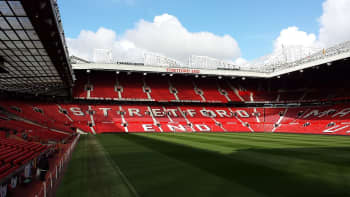
The fault lines in the relationship between club and fans continued to shift until the 2005 Glazer takeover resulted in a full-on earthquake. The Stretford End, which had had a second tier added to it in 2001, taking the capacity up to 14,000, was the site of significant activity in the anti-Glazer resistance, with an effigy of Malcolm Glazer even being hung from a noose at the front of the second tier then burned outside the stadium. In 2010 it was the location of banner drops and huge visual scarf protests during the anti-Glazer “green and gold campaign”. But for the most part, by the mid-’00s to early 2010s, the Stretford End had lost much of its bite.
Stretford End arising
The mid-2010s, the immediate era after legendary manager Sir Alex Ferguson's retirement was a time of growing identity crisis for United and its fans. The successive appointments of David Moyes, Louis van Gaal and Jose Mourinho brought increasingly dull football to a crowd used to speed, width, urgency and excitement. Bar a few exceptions for European nights and bigger games, the atmosphere across the stadium started to get as lifeless as the football.
Fans tried to get the club on board with measures that would support their efforts to generate better atmosphere, but things came to a head when United manager Jose Mourinho, never one to shy away from levelling criticism at his own club, players or fans, made a series of disparaging comments about the home atmosphere in 2017 and 2018. A series of comments about fans having to “improve” and “do better”, the crowd being “very quiet” and “not very enthusiastic” and Old Trafford being “a quiet stadium” didn’t land well with fans who felt that they had been fighting the club over atmosphere-related concerns for many years. Established fan groups and newer fan groups alike decided that it was time for some serious changes to be made.
In 2017, a new group called The Red Army (TRA) was formed by concerned fans, members of established fan groups and high-profile supporters, to generate ideas for improving the atmosphere and to try and get the club on board with making changes. They trialled a new singing section that fans from across the stadium could opt to move into on a game-by-game basis. Though initial uptake was slow, numbers soon started to grow as fans bought into the idea. In 2019, they were offered a permanent home in the right side corner of the Stretford End. From experimenting with various parts of the stadium, their focus became clearer - their target now was to reclaim the Stretford End.
Progress was slowed due to football stadiums being closed due to the COVID-19 pandemic, but over the last five years TRA have helped to completely re-shape the Stretford End.
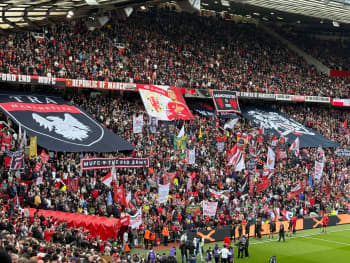
As TRA were growing their numbers in the stands, the Manchester United Supporters’ Trust (MUST) were trying to grow their influence in the boardroom. In 2018 they released an open letter to launch the “Reclaim the Stretford End” campaign, highlighting the issues supporters felt had caused the Stretford End to lose its spark, and calling on the club to take measures to try and return the Stretford End to being that beating heart of Old Trafford; relocating the Family Stand and the executive seating, converting those seats into “safe standing” rail seats which would allow fans to stand up throughout the game, protecting lower ticket prices, and incentivising younger fans - the kind who would have stood on the Stretford End back in the '70s and '80s - to move into the Stretford End through offering cheaper youth tickets.
“In the second half, going and playing towards that Stretford End, when you are tired and you are in pain and you are suffering, you want to be going towards that Stretford End, 100%.
Because they keep you going and when you have an opportunity or get close to goal, they are screaming and shouting and it really does give you a lift.”
- Marcus Rashford, January 2023 -
Credit: Ivar Aune
In January 2023 Manchester United announced that following consultation with the club’s Fan Advisory Board they would be replacing the much loathed executive seats in the middle of the Stretford End with general admission season ticket seats during the close of the 2023/24 season.
New season tickets were offered in those seats, with discounts being offered to fans under 25 years of age. A new, younger, more vocal set of fans moved in. In October 2025,the entire second tier of the Stretford End was converted to 6,000 rail seats, taking the total rail seating in Old Trafford to 13,577, or 18% of the total capacity. This meant that almost all of the proposals in the original 2018 “Reclaim the Stretford End” campaign letter would soon have been delivered, fully or partially.
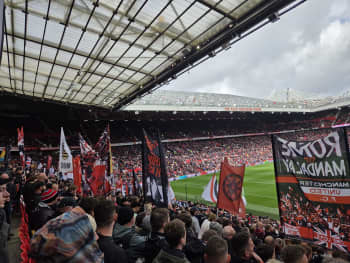
In the 2025/26 season, the Stretford End has been transformed. Visually, at least. At the start of the season, TRA decided to try and bring in some new flags, in a visual echo of those that adorned the terraces of the 1960s, ‘70s and ‘80s. It was important to them that this was led by the fans - funded and designed by those who were going to use them, without club involvement. They started a crowdfunder to fund the flags. United fans contributed almost £10,000. 300 designs were submitted by fans which were printed up. Seventy were on display at the Arsenal home game start the start of the season. It grew over time, with more flags added as those in the stands caught on to the idea of holding them, waving them, and returning them. By the end of the season, there were 300 flags being put out by TRA and waved by fans across the lower tier at the start of games. It makes for a truly spectacular sight.
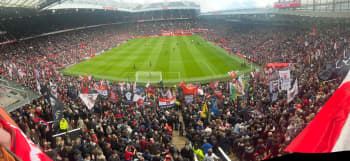
But have they actually had an impact on the overall atmosphere? Stadium reconfiguration and ticketing policies can only do so much - ultimately it is the fans who occupy those seats who generate atmosphere. Has “reclaiming the Stretford End” delivered tangible improvements? Or are fans just chasing the tail of something that has long been irretrievably lost?
Stretford native and season ticket holder Dave Pye, who went to the Stretford End in the 1980s and now sits at the opposite end of the stadium, told me: “I think the TRA have been amazing. The atmosphere it creates… and even though it doesn’t always spread around the ground for the whole game, the visual spectacle of all the flags gives the whole ground such a lift.
“And you’ve got to be commended for trying. In the modern day, when people can’t sit together with their mates, it’s hard to get a big crowd atmosphere going, even at big games. So I think everything they’ve done, I think it works, it really works.”
Melgie, 67, goes to every United game home, away and in Europe. He still has a season ticket in the Stretford End, 53 years after his first visit in 1973. He said: “They banned flag poles at Old Trafford in 1969, because people were using them as weapons. It’s great to see the flags back at Old Trafford. I absolutely love it.”
Fans seem united on the positive impact the TRA have made this season. In a poll I ran on X, the majority of fans agreed it had made a positive difference of some sort.
Fan groups and individual fans are clear on what they want to see happen next. MUST are pushing for rail seating to be installed across the whole lower tier of the Stretford End. While rail seating isn’t a panacea for atmosphere, it gets rid of the tension between stewards - tasked with enforcing ground regulations around ensuring fans stay seated in all-seater areas - and fans, which leads to an atmosphere more conducive to singing, celebrating and general positivity. Debate is ongoing about music before kick-off and after wins, with many in TRA saying it prevents them from generating organic atmosphere, others believing it adds to the experience, particularly in quieter areas of the ground. A survey of matchgoing fans by the club at the start of this season found a 50/40 split in favour of the pre-match music, with 10% unsure how they feel about it. TRA want to expand the flags across the rest of the stadium next season. A trial in Tier 2 of the Stretford End at the end of the season didn’t quite pan out as hoped, but they are optimistic that they can galvanise other sections of the ground.
Hanging over the future of the Stretford End is the proposed new stadium development. Manchester United are clear about their intent to push forward with plans for a new stadium, which will mean saying goodbye to the Stretford End for good.
For now, whether there is a new stadium or not, the focus for many fans is on trying to draw more younger fans in, and fighting to ensure ticketing policies and pricing allow that next generation of reds to build their own groups that they can carry into a new stadium, if and when it is built.
Melgie summed up the ongoing concern of older fans: “If we don’t address prices, make it cheap, we risk the youngsters going to Man City, where you can pretty much buy one ticket and get offered three more for free. We can’t lose that next generation. United is too important.”
 Built with Shorthand