
Exposure: What role does fear play in your life?
From leaping off cliffs to handling cockroaches, British-Cypriot Fear Coach Louis Allan guides people to confront what terrifies them most
His step is quick but grasp firm. He scales the rooftop ledge, peddles his feet and folds himself over his legs to stretch. A grin on his face, eyes glistening, as though signalling the secret to nine lives. I stand bewildered, camera in hand and terrified, ready to film what will shortly transpire.
Louis Allan is preparing to jump from a water tank to the edge of a 14-storey building. We are 40 metres above ground, sun-kissed rooftops of downtown Nicosia reverberate the police sirens below. There are no safety nets, no harnesses. This is not a drill.
Meet Louis Allan. Photo: Athena Vlachou
Meet Louis Allan. Photo: Athena Vlachou
Nor is it a feeble attempt at thrill-seeking. The stunt he prepares grounds a philosophical reckoning that has plagued him for years: how does one face fear?
At 34, Allan has established himself as a fear coach. Through his company, Exploring Fear, he holds one-to-one sessions and runs workshops of up to 25 participants around the world, teaching people of all ages and backgrounds how to tackle their greatest fears.
“Fear has a huge influence over our lives and our behaviour whether we’re aware of it or not,” said Allan. “In society it’s seen as a negative emotion, a vulnerability that we don’t talk about and must cover up.”
For Allan, fear must be unveiled and addressed head-on. His signature technique is graded exposure – a process of conditioning, in which you expose yourself to fears incrementally and in a controlled environment, scaling the intensity each time.
A few days prior to his gut-wrenching stunt, we met in a park across town in the Cypriot capital. Allan, wearing an old white t-shirt, his build moderate, beard dark, long and curled, and hair half-shaven, was surprisingly soft spoken. I would not have guessed that someone so gentle in demeanour – even shy at times – would spend his days hanging upside-down from cranes, throwing triple flips from 20-meter cliffs, and jumping between rooftops.
Running away from frightening experiences is the root of suffering, he said – a nod to the Greek 20th- century existentialist poet Nikos Kazantzakis. “When we stop doing that and face our fears, then we are free.”
Meet Louis Allan. Photo: Athena Vlachou
Meet Louis Allan. Photo: Athena Vlachou

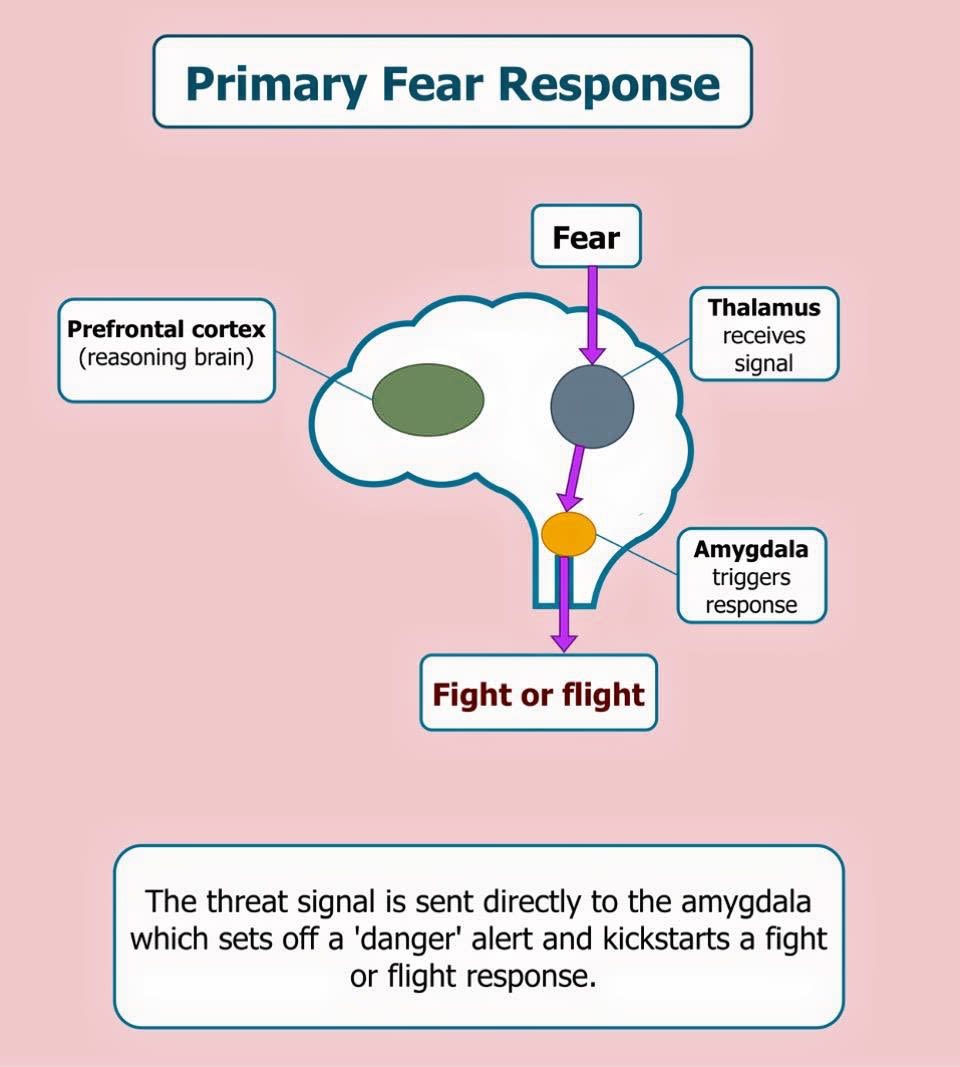
The Brain's Primary Fear Response. Source: Nature. Created using draw.io. Athena Vlachou
The Brain's Primary Fear Response. Source: Nature. Created using draw.io. Athena Vlachou

The Brain's Secondary Fear Response. Source: Nature. Created using draw.io. Athena Vlachou
The Brain's Secondary Fear Response. Source: Nature. Created using draw.io. Athena Vlachou
But what is fear?
A trained physiotherapist, Allan has spent the past five years fear coaching and two decades practicing parkour – an extreme activity where practitioners navigate urban environments, often from heights, using only their body. In these moments, physical and often dangerous, Allan came to understand that fear, whether ignited by a physical or emotional threat, instilled a similar reaction in him – something he later learned was because the brain goes through the same mechanism of registering fear.
Fear, he explained, is the marriage of physiological and conceptual processes. First, the body perceives a threat and triggers an adrenaline-fuelled survival response that pushes us into fight or flight. The conceptual follows, as we try to rationalise the experience by coming up with explanations to make sense of our reaction.
Allan believes we tend to calm our brain through reasoning after we have left a stressful situation but that we must learn to attune ourselves to our initial physiological response in real time – something which can only be achieved as we experience fear. This is where graded exposure becomes a core strategy.
“You want to be uncomfortable, but not in a panic,” he said. “Say you’re afraid of heights, you could start at a height of two metres. At first, your body will send off alarm signals and your heart will race. But you’ll start looking over the ledge and realising that you’re physically safe. This is the conditioning. You keep repeating this until you don’t get the same alarm bells, then you go a little bit higher.”
This is not to say that risk isn’t inherent when confronting danger. On the contrary, he said, it must be expected. We can address this by removing the environmental threat or by developing our skillset to navigate more threatening terrains. Allan believes that we spend too much time on the former and often neglect working on ourselves.
Additionally, as the brain responds similarly whether we perceive physical or emotional threats, the same methods of exposure can be used to ignite a fear response. While Allan's preferred entry point to fear are physical triggers, this is merely one avenue to learning how to tackle all sorts of fears daily, whether in our personal or professional lives.
“If you look at fear and your relationship with it, you realise that the root issue isn’t what you are afraid of, but your capacity to handle it,” he said.
“I use the physical as a metaphor for dealing with fear – like a leap of faith. There’s nothing more appropriate than jumping off a cliff for dealing with fear.”
Meet the participants
London physicist, and parkour enthusiast, Paolo Pichini, 30, was drawn to Allan’s mastering-of-the-mind approach and attended one of his workshops, which involved branch-to-branch tree jumping while barefoot.
Being barefoot allows participants to collect sensory information from the environment but also slows them down, preventing them from attempting jumps they are not yet ready for, said Allan.
This wasn’t an ordinary climb for Pichini, whose naked feet, combined with a two-metre drop to the stones and roots beneath him made the experience jarring.
“At the beginning, it was really tense and I didn’t feel safe at all,” he said. “The idea of throwing myself into the open air wasn’t comfortable. If you mess up, you can injure yourself or die.”
Paolo Pichini balances barefoot on a tree branch. Beyond Fear workshop London 2024. Photo: Samuel Ashton Rielly
Paolo Pichini balances barefoot on a tree branch. Beyond Fear workshop London 2024. Photo: Samuel Ashton Rielly
Allan looks on as Pichini practises a tree‑balancing exercise. Photo: Samuel Ashton Rielly
Allan looks on as Pichini practises a tree‑balancing exercise. Photo: Samuel Ashton Rielly
But Allan was empathetic, Pichini said, encouraging them to vocalise their thoughts as they moved through the exercise – a technique Allan refers to as ‘naming’. This, Allan said, activates the prefrontal cortex of the brain (the emotion-regulating, decision-making part) which immediately quietens the amygdala – or threat-detector – and stops fear from building.
“Instead of thinking, ‘I’m afraid’, you’re simply noticing what is happening,” Allan explained. “You can instead say ‘Oh my heart is racing because I’m doing this thing’”.
Naming helped Pichini situate himself in his environment and navigate the risks more efficiently, finding manageable ways to tackle the task.
The internal dialogue was meditative: a convergence of the body and mind to create an internal gym of sorts.
“It’s like being in a playground where you can see what happens to you,” said Pichini. “It’s separate from the chaos of everyday life. You can sit in the middle of the playground and see the frustration, the patience, the boredom, and fear inside you – you can see all these things.”
What’s more, sharing his fear among other participants allowed him to identify his own experience in others, creating communion.
The skills he picked up at the workshop – noticing and voicing his thoughts aloud – would prepare him for a more daring step he had dreaded taking in his personal life: confronting the fear that sharing his true feelings of concern with a friend would culminate in the loss of the friendship.
“It’s the fear that showing myself to the world will produce a negative reaction – that people will think ‘yuck!’”.
I was taken aback by Pichini’s candour – how readily he offered his innermost thoughts – thoughts I’ve admittedly held myself. When I asked him why he felt so comfortable sharing them, he smiled. “I heard somewhere that fear is an arrow pointing you in the direction you want to go,” he said.
Sharing became an empowering tool for him to move forward in life. Despite his fears – or perhaps because of them – he mustered the courage to tell his friend how he felt, a confrontation that ultimately improved their relationship.
Pichini reads his action plan for facing his fears aloud to the group. Photo: Samuel Ashton Rielly
Pichini reads his action plan for facing his fears aloud to the group. Photo: Samuel Ashton Rielly
Not everyone tree-jumps
Thirty-year-old AI engineer Simoni Panayi met Allan at a party where she told him about a near-death experience she’d had a decade earlier while driving on the highway.
“As I'm speeding up, I see a giant beast cockroach in the glove compartment and I lose it… I start screaming, I let go of the steering wheel, and I press on the gas, and the car just swerves,” she recalled.
“I was just swerving, screaming, and the cockroach was approaching me… It landed on the steering wheel then it fell on me.
“I was approaching a cliff…
“I said to myself, ‘either you're going to die or you’re going to lock-in and take control of the car right now.’ And I did. I stopped, got out of the car, and I ran – I sprinted. I’m convinced I hit the world record.”
The incident had a profound impact on her, leading to visceral reactions every time she encountered a cockroach – instances of chair-throwing, table-turning and shoe-losing. During the summer months, cockroach season in Cyprus, where she lives, even going outside became difficult. She’d find herself secluded in her apartment.
“It's going to attack you. It's going to come find you”, she’d think. “It became personal. If there was a cockroach around, it was going to harm me.”
Encounters with cockroaches brought on a feeling of chaos which felt like a threat to her life.
Working with phobias or even generalised anxiety can be challenging and is often an ongoing process, Allan said. “The trouble is, we are not really good at discerning when something is an actual or perceived threat."
As such, understanding the narratives which have shaped a person’s fears helps Allan find nuanced ways to challenge their phobias by testing them against reality, he said.
Simoni Panayi holds a cockroach image on her iPad, the kind used during her exposure sessions with Allan. Photo: Athena Vlachou. Cockroach image: Adobe Stock.
Simoni Panayi holds a cockroach image on her iPad, the kind used during her exposure sessions with Allan. Photo: Athena Vlachou. Cockroach image: Adobe Stock.
Panayi took weekly private sessions with Allan for five months. At first, they were conceptual because even talking about a cockroach would elicit anxiety. This included ‘visualisation’ – imagining scenarios involving cockroaches, and, crucially, how she would exit a given scenario. This would help prepare her for an inevitable cockroach encounter.
The exit scenario would often require an embodied technique. To prepare her in the event that a cockroach crawled into her hair or clothes, Allan instructed her to enact shaking it off her body. Somatic shaking – also seen in animals like cats after a scare – regulates the nervous system by releasing tension in the muscles, he explained.
As Panayi became more comfortable imagining the bug, Allan presented her with a plastic cockroach on wheels – pulled backwards and released, like a Hot Wheels toy car, sending the thing flying across the room.
The emulation of a flying cockroach was terrifying.
“At the beginning, I couldn’t even touch it,” said Panayi. “It looked like a real cockroach but not exactly. I couldn’t tell at first. It had the colour and the hairy leg texture. It was disgusting. I started off just feeling the plastic and convincing myself that it was plastic.”
Over time, Panayi began setting the toy off herself, which gave her control over its flight and motion. Eventually, she took it home. It now sits on her work desk.
As summer neared, Allan gave her the toughest task yet. He asked her to open a manhole in the garage beneath her building – revealing an oozing swarm of cockroaches. The familiar feeling of terror and panic arose as she reached for them in her hair and clothes. Allan stood nearby, steadfast.
“Don’t freak out. You’re fine. Just look at it. Look how far you’ve come,” she reassured herself.
And so, the two of them sat together for a long while, watching the tiny creatures go about their day.
“At some point I realised that this isn’t happening to me," she said. "Cockroaches are just things that exist simultaneously to me. It’s not personal to me, it’s not about me”.
Panayi rests her flying toy cockroach on her eyelid. Photo: Simoni Panayi
Panayi rests her flying toy cockroach on her eyelid. Photo: Simoni Panayi
These days, Panayi continues to implement the exposure skills, going out of her way to photograph a cockroach when she sees one. And while she is certain that she is not likely to touch a cockroach any time soon, she knows that if she were to discover a cockroach in the glove compartment of her car, she would be able to drive herself to safety – and that she wouldn’t die.
Pichini, who is now obsessed with tree‑jumping, no longer tries to ‘defeat the dragon’ but instead approaches fear like learning, with slow, measured progression. He continues to meditate and speaks his mind more often.
As for what they think of Allan:
“He is patient and does not judge,” Pichini said. “His workshops can transform your life and make you able to follow the things you burn for.”
However, while sessions with Allan can be illuminating, it is up to each participant to commit to the often-difficult work of looking inward and confronting one's weaknesses, Panayi said.
As we prepare to leave the 14th floor – to my great relief – I ask Allan if he knows of the impact he has on his clients’ lives. He seems to shy away: they are empowered by the skills they learn, not by him, he says.
As I pack my camera away, I wonder if he is being modest or clueless. He turns to me, eyes alight – just as when he had scared me half to death with his impossible stunt moments earlier – and asks the inevitable question, the same yearning question that kickstarts all his sessions:
“So… What role does fear play in your life?”
 Built with Shorthand