
Does anybody care about old street nameplates?
Historic street signs across Britain are slowly disappearing - yet it seems councils hold no record of what is being lost
On a street corner in Newlyn, West Cornwall, a weathered blue enamel street nameplate hangs slightly crooked against a granite wall above a charity shop.
The paint has dulled with salt air and decades of rain. Rust blooms faintly around the edges and through the white lettering. It has been there for more than a century, hanging on by a couple of screws.
It has survived the dawn of tarmac roads, World Wars, the Ash Wednesday Storm of 1952 that destroyed the bridge a few yards away, and Newlyn’s slow transformation from a tight-knit fishing village into a bustling tourist and foodie hotspot.
Ghost sign researcher Sam Roberts describes old signs as “portals” into ordinary places and communities of the past - traces of businesses, industries and local life that rarely survive elsewhere.
“There’s everyday history written into signs,” he said.
Like the other navy blue enamel nameplates scattered around Newlyn, this petite street sign on Jack Lane isn't famous or protected. It discreetly perches on the wall like a fading ghost from an ever distant past.
I grew up on Jack Lane and first noticed it when I was very young. Darker than modern street signs. Smaller. Slightly uneven. Over the years, I would notice similar nameplates scattered around the village and quietly admired them whenever I passed one. They belonged to another time and felt custom-made to my little corner of the world.
In recent years, I noticed the sign on Jack Lane looking increasingly weathered, so I photographed it and zoomed in, only to find it now has just one reliable screw left holding it onto the wall.


Jack Lane, Newlyn
Jack Lane, Newlyn
That was when I started wondering: What happens when these unique pieces of local history finally fall apart? And does anyone care?
At first, the question felt niche. They are only street signs, after all. But the more I researched them, the more they began to feel like part of the visual fabric of towns themselves - small pieces of history that most people interact with every day without ever really noticing.
Street nameplates reveal how places evolved, how councils once developed distinct local identities, and how fragments of older Britain still survive quietly in plain sight.
Unlike museum objects, street signs remain embedded in daily life. People navigate past them constantly, often without noticing that some have survived for generations.
“They survive almost accidentally.”
Venton East Square, St Just
St Peters Hill, Newlyn
Chapel Street, Newlyn
Chapel Street, Newlyn
St Peters Hill, Newlyn
St Peters Hill, Newlyn
During surveys of Newlyn and nearby St Just, I documented the surviving navy enamel street nameplates alongside modern aluminium and plastic replacements, including examples where historic and contemporary signs now stand side by side on the same streets.
Nameplate expert Alistair Hall confirmed that these signs date back more than a century - and very few remain. I could find seven in Newlyn and only two in St Just.
Cornwall Council confirmed it holds no archive or historic record of street signage.
That means some of Cornwall’s oldest surviving street signs like these, could disappear through routine maintenance work or decay, with little formal record of what existed before. Most people probably won't notice these signs disappearing at all, nor care.
But the fresh screws found on the signs in Church Street and Gwavas Road suggest some residents do care about them.
The Nameplate Index invites anyone who is interested to start sharing old and unique nameplates from across the UK.
The project aims to promote awareness of nameplates and their significance, combining photography, mapping and public submissions to document historic or unusual street signs that anyone can discover and share.
- instagram: @nameplateindex
What initially seemed like a hyper-local Cornish curiosity quickly expanded into something much larger. The deeper I looked, the clearer it became that Newlyn was not unusual at all.
Similar age signs survive across Britain - from cast iron plates in Yorkshire to black Victorian nameplates in Oxford. I was even able to locate some similar small blue enamel nameplates in Bristol, where I live now, although these adorned tidier typefacing, the logo of the Patent Company in the corner, and have clearly not faced the same levels of sea spray.
Sam Roberts has spent nearly two decades documenting fading painted advertisements (like the Whitbread one in Bristol, pictured) through his Ghost Signs research, and agreed that nameplates can share the same vulnerability and historic significance (or indeed - insignificance).
“They survive almost accidentally,” he said.
That accidental survival is also what makes them vulnerable.
Unlike listed buildings or monuments, most street signs receive little to no formal protection. They are treated primarily as practical objects. When damaged, they might be replaced. When buildings are renovated, they can be painted over. When streets are redeveloped, they can disappear. Roberts believes signs occupy an awkward position between architecture and archive.
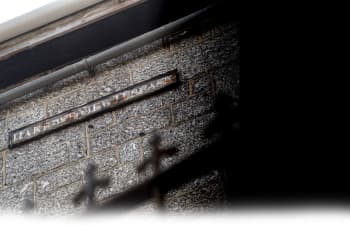
A recent Kindersley style nameplate sits around the corner from it's extremely old wooden counterpart at Harbour View Terrace in Newlyn.
A recent Kindersley style nameplate sits around the corner from it's extremely old wooden counterpart at Harbour View Terrace in Newlyn.
“They’re not integral to the architecture of the building,” he said.
"But equally, they can’t really be placed into museums because they’re so site specific.”
As towns change, signs often disappear quietly through repainting, redevelopment or replacement.
“There’s always renewal in urban environments,” Roberts said.
Interestingly, Roberts does not believe preservation laws are necessarily the answer.
“Quite early on in my journey, I realised that protection efforts are either futile or unlikely to be hugely successful or enforceable,” he said.
“I didn’t want to be doing placard-waving or lobbying council meetings. It just felt like a lot of energy expenditure for probably not much of a reward.”
Instead, he believes awareness matters more.
“We need more people to understand what they are, how old they are, and what they represent.”
Before digital maps and smartphones, street nameplates formed an essential part of civic infrastructure compared with today.
If you go back far enough, there are records of when they were a new phenomenon.
In 1811, the Royal Cornwall Gazette praised the Mayor of Penzance for “affixing names to the streets of that large and populous town” after visitors struggled to navigate unnamed roads.
Royal Cornwall Gazette, Saturday 27 July 1811
Royal Cornwall Gazette, Saturday 27 July 1811
By 1856, the Cornish Telegraph reported that “every terrace, street row, and lane” had been “distinguished by sign, legibly painted and fixed in a conspicuous spot”.
The article joked that visitors could now “use [their] eyes more and [their] tongue less”.
Cornish Telegraph, Wednesday 06 August 1856
Cornish Telegraph, Wednesday 06 August 1856
At the time, the new street nameplates represented progress - part of a growing public system designed to organise expanding towns and cities. Now they sit quietly in the background, overshadowed by sat nav, fading into walls - still important, but not nearly as crucial as they once were.
These news reports demonstrate how the rapid expansion of transportation, industry, and cities increasingly depended on visible, standardised street naming systems for postal services, commerce, and public administration. It ran parallel with the railroad, leading to Greenwich Mean Time. The Industrial Revolution marked the beginning of rigid and universal systems that extended beyond relying on in-person verbal communication.
“We need more people to understand what they are, how old they are, and what they represent.”
Roberts believes that people do care.
“You’d be surprised,” he said. “There is a community out there that would be into this stuff.”
Roberts pointed to the growing popularity of historic signage communities online (especially in his area of Ghost Signs) as evidence that people are increasingly interested in the overlooked details embedded in public spaces.
“Who would have thought fading painted signs would be a thing? And it is,” he said.
For Roberts, the appeal lies partly in the fact that every town contains its own hidden details waiting to be noticed.
“I’d like to think there’s someone in every single town who would potentially go, ‘Oh, we’ve got a sign that’s quite interesting.’”
Signage historian and designer Alistair Hall has spent years researching British street nameplates and the companies that produced them, even publishing a photographic book dedicated solely to London nameplates.
Hall's book on London street signs
Hall's book on London street signs
According to Hall, many of Britain’s historic street nameplates were never intended to become heritage objects at all. They were industrial products.
Historically, Hall explained, there were “few strict national standards governing street signs”, with councils instead inviting manufacturers to tender for contracts and selecting from different available styles and materials.
“There was general governmental guidance on the design of signs, but nothing mandatory, so most local councils invited various companies to tender for their signs, and whoever was accepted, one of their available design styles would be chosen,” he said.
The result was a surprisingly varied visual landscape that changed from town to town depending on which companies local councils selected.
While researching historic signage, Hall uncovered a 1925 Irish Times report listing companies competing to manufacture Dublin’s street signs.
Some of the leading British sign makers in 1925. Competition was high in the Midlands
Some of the leading British sign makers in 1925. Competition was high in the Midlands
Many surviving nameplates still scattered across Britain today were produced by companies like these - specialist manufacturers producing vitreous enamel plates by fusing glass onto metal at extremely high temperatures.
Hall identified the signs in Newlyn as exactly that type of craftsmanship.
“The [enamel signs in Newlyn] are probably late nineteenth, early twentieth century,” he said.
What now looks like ordinary street furniture was once specialist industrial design.
Hall also explained that many older signs carried no maker’s marks at all, meaning their origins can now be difficult to trace once council records disappear.
What survives today is often fragmented. A nameplate in Cornwall is likely to look entirely different from one in Yorkshire or London, not because of national rules, but because individual councils quietly developed their own visual identities over decades of local decision-making.
Much of that variation disappeared during the twentieth century as signage became increasingly standardised.
Love Lane in Penzance has the Kindersley typeface, with Cornish translation
Love Lane in Penzance has the Kindersley typeface, with Cornish translation
You don't have to walk far from home to find traces of one of the biggest design battles in British public life: the fight over the lettering used on modern road signs.
In the 1950s, letter cutter David Kindersley designed a serif typeface specifically for British street nameplates and road signage.
His lettering became widely adopted by councils across the country and is still used on street nameplates today.
But when the government commissioned a new national motorway signage system, Kindersley lost out to designers Jock Kinneir and Margaret Calvert, whose cleaner sans-serif “Transport” typeface would go on to define modern British transport road signs.
Modern signs tend to use the standardised black-on-white system familiar from highways and council replacements. Older signs often use heavier serif lettering, decorative spacing and locally distinctive layouts tied to particular places rather than a single national system.
Even within standardisation, local variations still survive.
In Oxford and parts of the Midlands, some councils continue using white lettering on black street nameplates — not because it is national guidance, but because councils chose to preserve it as part of local identity and historic streetscape character.
A sign in Cornwall can still look completely different from one in Oxford or Yorkshire.
Together, they begin to feel less like infrastructure and more like fragments of an unofficial public archive scattered across the country.
Worcester Place/Walton Street in Oxford demonstrate the white text on black background.
Worcester Place/Walton Street in Oxford demonstrate the white text on black background.
Abbey Road in Oxford, with Kindersley typeface shows how the white on black design has been upheld by local authorities.
Abbey Road in Oxford, with Kindersley typeface shows how the white on black design has been upheld by local authorities.
Queens Terrace, Scarborough
Queens Terrace, Scarborough
Salisbury Street, Scarborough
Salisbury Street, Scarborough
Victoria Road, St Austell
Victoria Road, St Austell
Liverpool often opts for a Sans Serif typeface.
Liverpool often opts for a Sans Serif typeface.
Bristol’s current Street Naming and Numbering Policy shows how far modern signage has shifted towards regulation and uniformity. Modern signs are now treated primarily as infrastructure.
Yet despite the level of detail surrounding how new signs are installed, there is little emphasis on preserving older ones. Unlike Cornwall Council, Bristol City Council told me it aims to replace signs like-for-like “especially within conservation areas.”
Elsewhere, signs may instead be repaired, repainted or replaced entirely, depending on condition and budget.
That inconsistency is part of what makes the surviving historic signs, like the ones found in Newlyn, feel so fragile. Let's enjoy them while they last.
Thanks to Alistair Hall, Sam Roberts, Penwith Local History Group and Kresen Kernow for their support in the research for this feature.
 Built with Shorthand