'I always thought vaping couldn't hurt me':
Are e-cigarettes really a safer alternative?


When Kai woke up he thought he was under the weather. When he sat up, he thought he was dying.
If you were to ask a 20-year-old student about the last time they woke up in pain, it’s likely you would be told hangover related anecdotes.
After all, these are the years of your life where you are supposed to make reckless decisions with no repercussions, right?
For Kai Boswell, a musician and student from Oldham, it’s these attitudes that landed him in hospital.
“Heavy vaping” had collapsed his lung.
Following the terrifying ordeal, Kai was rushed to the Royal Liverpool Hospital last month, where it was discovered he had a “fully collapsed lung”.
It was only after countless scans and surgery that the Liverpool Institute of Performing Arts student discovered he had blisters on his lungs that were not from “cigarettes and weed”, with vaping being the “likely cause”.
He said: “I always had this idea in my head that vaping couldn’t hurt me … it’s honestly just proved to me that it can hurt you in the same way or in worse.”




Just as Kai was recovering, news had broken about the early findings of a Manchester Metropolitan University study into the effects of vaping.
The breakthrough study suggested that the flashing fruity flavoured vape Kai had once viewed as a ‘safer alternative’ to cigarettes could be just as harmful.
The results had even shocked Dr Maxime Boidin, leader of the world’s first controlled study into vaping's long-term effects, who said his results indicate the dangers for someone who vapes are “no different from smokers”.
After giving volunteers fitness tests which measured things such as blood flow to the brain, results indicated that long term vapers could be equally at risk of dementia, heart disease and organ failure as regular cigarette smokers.
Dr Boidin believes the correlation could be due to inflammation caused by nicotine, as well as the metals and chemicals found in vapes, which include propylene glycol and vegetable glycerine.
As the flavourings used in vape liquids often contain chemicals such as carbonyl compound, the report suggested that vape consumption can also lead to artery inner wall damage and cell death due to inflammation and oxidative stress.




Boidin, whose study concludes this month, said: “Smokers tend to go outside and smoke, and once a cigarette is finished they have to light up another to keep going, but with vapes, you just keep going and it’s much harder to know how many puffs you’ve had.
“It’s much easier to vape continuously because you can do it in places where smoking might be less acceptable.
“At the beginning (of the study) I also believed that vaping was more beneficial than smoking. You see a lot more people vaping these days because they don’t think it’s too bad. Many will be horrified to know the truth.”
Since the bombshell study’s initial findings were released last month, headlines across the UK were quick to include the claims.
Charities such as Action on Smoking and Health, ASH, have been critical of the reports, believing that we shouldn’t “jump the gun” when reporting on the study.
The tobacco advocacy public health charity, which was set up by the World College of Physicians just over 50 years ago, has a primary objective of identifying ways to bring smoking rates down across the country.
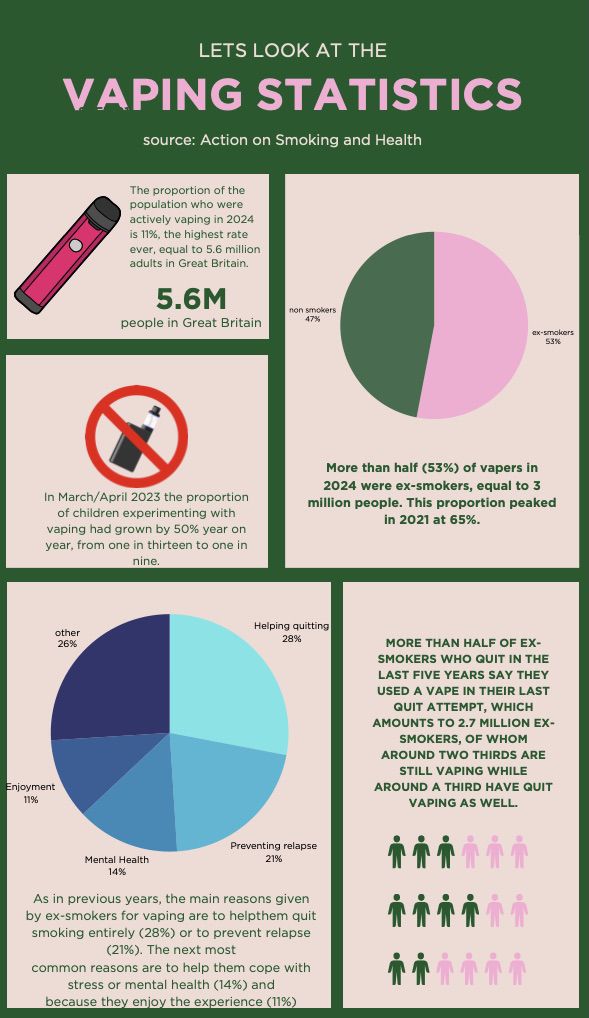
They follow the government’s policy that vaping is much less harmful than smoking.
Hazel Cheeseman, Chief Executive of ASH, said: “Given that we have a very substantial body of evidence which points to different health impacts, it seems quite a big swing to say that that evidence is invalid off the back of an unpublished relatively small study.
“It really matters because vaping has helped thousands and thousands of people to stop smoking and to feed the misunderstandings that vaping is less harmful than smoking undermines the likelihood that people will switch which really essentially could imperil people's lives.
“I'm sure that the researchers believe that what they found is important and worthy of that but really they should wait until it's had proper scrutiny and it's been peer reviewed before seeking such extensive coverage.”
Media coverage of the study has also worried members of the NHS, with Dr Matt Evison, a specialist in lung cancer and clinical lead for Greater Manchester’s Make Smoking History programme, fearing that reports will defer cigarette smokers from making the switch.
“You can never have the conversation about vaping without having the conversation first about tobacco,” he said.
“From a purely tobacco control perspective, vaping is a positive thing.
“It is a treatment for tobacco dependency, and it’s an effective way of helping someone to become smoke-free and reduce their levels of harm and risk, and from that early death and illness that tobacco inevitably delivers.
“Any discussion about vaping has to be in that scene, so for somebody that smokes, one of their best chances of becoming smoke-free is by using a nicotine vape.”







The tobacco control programme is aiming to make Greater Manchester a smoke-free region by 2030, with the physician saying that tobacco causes about 5,000 people to lose their lives in Greater Manchester each year.
He said: "In the last five years about three million people stop smoking with a nicotine vape, knowing two out of three of those would have died because of their smoking, so that public health benefit is substantial."
Evison argues that the discourse around vaping should be separated in two ways, from viewing vaping as a cure for cigarette smokers, to analysing the problem with young people taking up the habit.

Once a "heavy vaper" who could get through a 3,000 puff vape in a matter of days, Kai is just one of the many young adults who have taken up vaping despite having no history of smoking.
The Tobacco and Vapes Bill, introduced in November 2024, aims to promote public health by reducing tobacco use and regulating vaping products in the United Kingdom – targeted especially to young adults like him.
The key provisions of the bill include phasing out tobacco sales, extending age restrictions for vaping products and regulating vape flavours and packaging to deter children.
A timeline of the UK's vaping boom
2003- The first vape-like electronic cigarette was developed in Beijing by Hon Lik, a 52-year-old pharmacist, inventor and smoker.
It has been reported that Lik created the device after his father, a heavy smoker, died of lung cancer.
2006- Vapes were introduced to Europe and the USA, a year before the UK banned smoking in an enclosed public area.
2016- The UK implements Tobacco and Related Products Regulations, placing limitations on nicotine strength, tank capacity, and advertising.
2025- The Tobacco and Vapes Bill is currently in the Report Stage in the House of Commons.
If passed, the bill will make provisions about the supply of tobacco, vapes and other products, and will prohibit the sale of tobacco to people born on or after 1 January 2009.
The act will also aim to control the advertising and promotion of tobacco, vapes and make provision about smoke-free places, vape-free places and heated tobacco-free places.
Picking up the habit at 16 along with his peers at sixth form, Kai's “traumatising” ordeal has taught him a valuable lesson.
The musician, who regularly plays gigs alongside his studies, said he will not be back to his full ability for another three months, meaning he is unable to work and has missed vital time at university.
He said: "I haven't vaped since the day I went into hospital now, it's definitely, kind of traumatizing a little bit, for sure.
"It's been quite physically and kind of emotionally challenging to deal with that," he said. "For anyone wanting to vape, I would just say avoid it."
"For anyone wanting to vape, I would just say avoid it."
 Built with Shorthand